

- Description
- Curriculum
- Reviews
The fully online gamified Master’s Degree in Business Administration (PlayMBA) is a future-ready business program tailored for professionals aspiring to lead with innovation and strategic agility. Designed to deliver immersive, game-based learning experiences, this program merges academic excellence with interactive simulations, challenges, and real-world business scenarios. Post completion of the program, the learners will be awarded the degree from UTAMED, Spain. It is a fast-tracked, self-paced postgraduate programme designed for working professionals and aspiring leaders who wish to accelerate their managerial and strategic capabilities within a condensed timeframe. The programme allows learners to complete their degree at their own pace, offering flexibility, autonomy, and structured academic rigor aligned with contemporary business demands. The PlayMBA cultivates skills and competencies through a dynamic, engaging framework, aligning with global standards and occupational benchmarks.
This program is designed to equip learners for high-level managerial roles and entrepreneurial journeys, by blending academic rigor with the motivational power of game mechanics. This qualification aims to provide learners with:
-
An understanding of the essential skills required to work successfully in the Business management sector.
-
Develop critical business acumen in a competitive, digitally driven environment.
-
Apply strategic thinking through simulations, gamified case studies, and scenario-based challenges.
-
Enhance leadership, decision-making, and problem-solving through roleplays and point-based learning modules.
-
Experience collaborative learning through leaderboards, progress dashboards, and digital badges.
-
Master interdisciplinary business domains through experiential play-based activities.
-
The tools to prepare learners intellectually and practically for effective performance in their place of work / employment.
-
The skills required to solve problems in a business environment.
-
The readiness to manage the various organizations on a scientific basis and to hold leading managerial positions.
-
An understanding of business culture and responsibilities in the various domains of business management.
-
The ability to successfully communicate and work with others in a business environment.
-
The opportunity to develop the skills required to manage and improve their own performance in a business environment.
-
A comprehensive understanding of the Business and Management domains.
Credits Table:
|
Module Code |
Module Name |
ECTS |
|
PLYMBA001 |
Operations and Project Management |
8 ECTS |
|
PLYMBA002 |
Strategic Management and Leadership |
8 ECTS |
|
PLYMBA003 |
International Human Resource Management |
8 ECTS |
|
PLYMBA004 |
Strategic Change Management |
8 ECTS |
| PLYMBA005 | International Marketing Management | 8 ECTS |
| PLYMBA006 |
Sustainability and Business |
8 ECTS |
| PLYMBA007 |
Strategic Impact Simulation Project |
12 ECTS |
|
Total ECTS |
60 ECTS |
|
Module Descriptions:
Operations and Project Management:
This module transforms the traditional study of Operations and Project Management
into an engaging, simulation-driven challenge where learners play the role of operations strategists. Through a variety of immersive gameplay elements—such as real-time project simulations, factory floor decision games, and operational puzzle learners will uncover how strategic operations drive business excellence. The gamified environment encourages learners to design systems, solve bottlenecks, optimize flows, and plan projects using tools like PERT and CPM. As they level up through time-bound missions and case-based challenges, learners experience how operations intersect with marketing, finance, and information systems in a globalized, digital-first business environment.
Gamified Learning Outcomes:
LO1.Identify and master a range of operations tools and techniques by applying the right strategy in varied challenge scenarios—unlocking levels based on your ability to choose and apply the most effective solution paths.
LO2. Use real-time data and information systems as strategic power-ups to enhance operational decision-making, gaining competitive edge points and achieving global performance milestones.
LO3. Navigate complex business quests using project management maps (PERT/CPM), critically assessing the value of each move and decision to successfully complete real-world project missions.
LO4. Showcase your command of operations strategy across local and global gameboards, while analyzing how tech upgrades have transformed operational playbooks in the modern business arena.
Game Scenario
This simulation places you in charge of a cookie production facility where you plan, supervise, and execute end-to-end operations. The objective is to balance competing priorities, improve operational judgment, and deliver measurable results using modern operations and project management tools. Learners design production workflows, allocate resources, manage risks, and make data-driven decisions in a controlled, practice-focused environment. Players move through structured stages: scenario briefing, process planning, task and schedule design, execution and risk handling, and performance review through dashboards and KPIs. The activity emphasizes workflow design, forecasting, scheduling, supplier and inventory decisions, and continuous performance evaluation.
Strategic Management and Leadership:
This module transforms the complex world of strategic management and leadership into an interactive, simulation-rich experience. Learners will step into the roles of business leaders navigating turbulent markets, designing visionary strategies, and making high-stakes decisions through competitive game rounds, leadership roleplay, and global market simulations. With each mission, learners unlock new strategic models, explore organizational ecosystems, and apply theories like Porter’s, Miles & Snow, and institutional frameworks to evolving case challenges. Leadership styles and innovation pathways are tested in real-time through role-based quests and digital feedback loops, enhancing decision-making and strategic alignment in diverse global contexts.
Gamified Learning Outcomes:
LO1. Decode strategy concepts and theories and unlock insights into how strategic choices influence stakeholder alignment and boost organizational performance metrics in real-time missions.
LO2. Assess how shifting global force economic waves, political twists, and cultural dynamics—shape strategy gameplay in the international arena.
LO3. Craft winning business strategies in high-pressure scenarios driven by innovation and change, then critically evaluate how these strategies level up an organization’s success.
LO4. Design and activate strategic implementation plan while managing stakeholder expectations as key objectives—ensuring long-term rewards and team advancement.
Game Scenario
The Bite Cartel – Food Truck game is a strategy and leadership simulation where learners take the role of a business leader growing a food truck venture into a competitive brand. The game develops practical strategic management skills through scenario-based decisions on markets, positioning, innovation, stakeholders, and expansion. Across multiple rounds, players apply core strategy frameworks and leadership models to respond to changing market, global, and competitive conditions. Decisions on pricing, differentiation, growth, and resource use directly affect performance indicators such as revenue, innovation, stakeholder satisfaction, and operational efficiency. The simulation emphasizes strategic alignment, global awareness, change management, and execution discipline, supported by round-based performance dashboards and guided reflection.
International Human Resource Management:
This module reimagines International Human Resource Management as a strategic game of global talent mastery. Learner’s step into the role of international HR consultants, navigating challenges in diverse cultural settings, applying leadership styles through avatar-based quests, and solving people-centric issues in real-time simulated organizations. Learners engage in global workforce simulations, talent acquisition challenges, and behavioral roleplays to internalize cross-cultural HRM practices. Leadership and organizational behavior theories are taught through decision-based games, peer evaluation, and scenario branching—all designed to prepare future-ready HR strategists.
Gamified Learning Outcomes
LO1. Analyze the power of Human Resource Management (HRM) practices and how they can be strategically linked to organizational behavior mechanics—solving workplace challenges and boosting organizational performance through smart, people-driven moves.
LO2. Explore the leadership skill tree—critically evaluate leadership frameworks by unlocking different approaches (traits, behavioral, functional, style, contingency), and navigate the leadership continuum to select optimal styles based on mission-specific variables.
LO3. Delve into the engine of organizational behavior and its interface with management—synthesize the various internal and external forces influencing behavior and manage this dynamic balance to optimize team performance and decision-making outcomes.
LO4. Evaluate the global role of IHRM and identify key challenges in international arenas—unlock best practice badges by integrating effective HR strategies across borders and building resilient, globally competitive teams.
Game Scenario
This simulation includes four connected mini-games set in a fictional kingdom, each aligned to a key learning outcome in HRM, Leadership, Organisational Behaviour, and International HRM. Learners take on managerial roles and make scenario-based decisions on recruitment, leadership approach, organisational policies, and global workforce management. Player choices affect morale, productivity, and organisational stability, with earlier decisions influencing later international outcomes. The game focuses on applying management theories in practice through strategic decision- making, with scoring and debriefs used to link gameplay to real-world HR concepts.
Strategic Change Management:
This module transforms the understanding of strategic change into an interactive journey through high-impact simulations and challenge-based missions. Learners act as change agents within digital enterprises, navigating organizational transformation into volatile, uncertain, and complex environments. Using game elements such as decision trees, feedback loops, and scenario branching, learners develop insights into leading and managing change. Strategic interventions, resistance management, and behavioural shifts are all explored through case- based simulations, avatar-driven leadership scenarios, and real-time organizational dilemmas.
Gamified Learning Outcomes
LO1. Identify the key forces behind strategic change and analyze how they unlock pathways for successful organizational transformation—equipping change leaders with the right tools to navigate disruption.
LO2.Tackle real-time transformation quests by evaluating the management-level challenges organizations face during change missions—build strategies to overcome resistance and maintain performance under pressure.
LO3. Assess how chosen change strategies influence the gameboard of leadership and team behavior—critically evaluate the ripple effects on morale, motivation, and engagement throughout the organization.
LO4. Explore classic and modern management theory upgrades—evaluate how leadership attributes and management styles impact player performance, leading to enhanced contributions and team synergy in the workplace.
Game Scenario:
Critical Pulse is a strategic change management simulation set in a multispecialty hospital facing operational failure, public scrutiny, and internal resistance. Players assume the role of a strategic change consultant tasked with diagnosing the crisis, leading transformation initiatives, and restoring trust, efficiency, and clarity across the organization. Through decision-making tasks, dialogue simulations, audits, and stakeholder engagement activities, learners apply change management models, leadership strategies, and ethical judgment in a realistic healthcare context. Player choices dynamically influence key organizational indicators—trust, morale, resistance, clarity, and cost—shaping both the final outcome and overall performance score. The simulation emphasizes practical application of strategic change theory, human-centered leadership, and ethical decision-making under pressure, linking academic models directly to real-world transformation challenges.
International Marketing Management
Get ready to enter the global marketing arena, where strategy meets creativity and every decision impacts your score on the international business leaderboard. This module equips students with the knowledge and tools needed to master the dynamics of international marketing and management in a fast-paced, ever-changing global environment. Players (learners) will explore powerful theories and apply them in real- world marketing quests—unlocking insights into global markets, cross-border consumer behavior, and international branding tactics. From decoding global market environments to crafting winning market entry strategies, you’ll earn badges for developing innovative products and executing high-impact promotional campaigns across different cultural landscapes. By the end of this module, you’ll have the skills to evaluate key factors that influence international success and build strategies that win across borders—turning you into a globally-minded marketing champion.
Gamified Learning Outcomes
LO1. Scan and analyze shifting global business landscapes like a strategic radar— identify how these changes challenge marketing functions and adapt your tactics to stay ahead in the global game.
LO2. Level up your marketing mastery by designing powerful marketing plans using proven models, tools, and techniques—unlock strategic combos that maximize impact in diverse market scenarios.
LO3. Dive into the mechanics of brand management—evaluate how branding decisions influence consumer behavior, loyalty, and perception, and make the right moves to build brand equity that wins hearts.
LO4. Equip yourself with the creative skill set of a next-gen marketer—evaluate what it takes to successfully launch innovative products or services in a dynamic global marketplace and earn your place as a marketing trailblazer.
Game Scenario
The IMM Movie Marketing Theatre is an interactive simulation where learners work with multinational teams to plan and execute a global marketing campaign for a film release. Participants take on executive roles such as marketing director, distribution manager, and market analyst, and make strategic decisions on distribution, promotion, cultural adaptation, and launch timing across international markets. Through team challenges and role-based decisions, players analyze market conditions, respond to competitor actions and PR issues, adapt campaigns to cultural contexts, and optimize audience reach and revenue. Dashboards and performance indicators simulate box office analytics, showing the impact of decisions on market share, profitability, and customer loyalty. The simulation connects marketing theory to practice by applying global environment analysis, marketing frameworks, brand management, and product launch strategy in a realistic, decision-driven setting, with points, awards, and milestone rewards to enhance engagement.
Sustainability and Business :
Organizations within modern day business are required to redesign their strategies and policies to be aligned with a sustainability agenda. Corporate social awareness is now being seen to address economic, social and ecological issues from a sustainability standpoint, expanding the traditional reach of CSR. Sustainability awareness creates an environment for a more innovative organization and supply chains, with emphasis on biodiversity and closed-loop supply strategies. The module will critically review sustainability challenges and opportunities for organizations globally.
Gamified Learning Outcomes
LO1. Appraise the multiple dimensions of sustainability for businesses in the context of global challenges.
LO2. Critically review, evaluate and develop sustainability strategies of organizations.
LO3. Critically analyze the strategic alignment of the business functions to sustainability.
LO4. Critically analyze an organization’s global sustainability and your contribution to the impact on global sustainability.
Game Scenario
In this interactive simulation, you take on the role of both an early civilization leader and a modern sustainability strategist. Starting with ancestral farming, you will choose traditional agricultural methods, allocate limited resources, and balance water, labor, and soil health. Each decision affects crop yield, biodiversity, and long-term sustainability, teaching you how strategic planning and careful resource management influence community survival and prosperity. As the scenario progresses, you transition to managing a modern enterprise, making investments in sustainable industries, eco-innovation, and workforce welfare. Your choices impact environmental credibility, social responsibility, and innovation strength, highlighting the trade-offs between profit, people, and planet. By navigating these challenges, you gain practical insight into how integrated decision-making shapes long-term economic, ecological, and ethical outcomes in both historical and contemporary contexts.
Strategic Impact Simulation Project :
The Strategic Impact Simulation Project is a core component of the MBA program designed to enable learners to undertake an independent, research-based investigation of a complex business scenario derived from a gamified MBA module. Learners select a gamified mission scenario and conduct a research-based analysis to evaluate strategic decisions, outcomes, and leadership impact. The module culminates in the submission of a Strategic Impact Simulation Project, assessing the student’s depth of understanding, analytical rigor, and ability to communicate complex research effectively. The project requires learners to critically examine a strategic management challenge by applying relevant academic theories, analytical frameworks, and evidence from scholarly and industry sources. Through this project, learners are expected to demonstrate the ability to integrate knowledge acquired across the MBA program, formulate a clear research focus, analyze alternative strategic decisions, and evaluate their implications for organizational performance and broader business contexts. The project provides an opportunity to develop:
-
Critical thinking and decision-making skills in a global business context
-
Cross-functional integration across marketing, finance, human resources, operations, and sustainability
-
Practical experience in linking academic theory to business strategy
The work must be grounded in scholarly research and critical literature, ensuring that strategic insights and recommendations are supported by established theory and evidence-based analysis. The project therefore serves as a culminating assessment that evaluates learners’ independent research capability, analytical thinking, and ability to connect academic knowledge with practical managerial decision-making.
Learning Outcomes
Upon completion, learners should be able to:
LO1. Critically analyze a selected gamified business scenario by applying academic theories, frameworks, and industry evidence to identify and diagnose strategic challenges.
LO2. Design and evaluate alternative strategies using cross-functional knowledge to assess risks, model decision pathways, and anticipate outcomes.
LO3. Synthesize and interpret evidence, both qualitative and quantitative, to evaluate the effectiveness of decisions, demonstrating scholarly research skills, ethical awareness, and informed managerial judgment.
LO4. Develop actionable recommendations that are supported by critical reflection on leadership, professional development, and the broader societal impact of strategic decisions .
-
1
 Handout
 -
2
LO1 Notes
-
3
LO1 Reading Material
-
4
 LO1 Case Study Insights
 -
5
LO1 Game ⭐
-
6
LO2 Notes
-
7
LO2 Reading Materials
-
8
LO2 Case Study Insights
-
9
LO2 Game ⭐
-
10
LO3 Notes
-
11
LO3 Reading Materials
-
12
LO3 Case Study Insights
-
13
LO3 Game ⭐
-
14
LO4 Notes
-
15
LO4 Reading Materials
-
16
LO4 Case Study Insights
-
17
LO4 Game ⭐
-
18
Feedback Form: International Marketing Management
-
19
IMM_Game Reflection Note
-
20
Handout
-
21
LO1 Notes
-
22
LO1 Reading Material
-
23
LO1 Case Study Insights
-
24
LO1 Game ⭐
-
25
LO2 Notes
-
26
LO2 Reading Materials
-
27
LO2 Case Study Insights
-
28
LO2 Game ⭐
-
29
LO3 Notes
-
30
LO3 Reading Materials
-
31
LO3 Case Study Insights
-
32
LO3 Game ⭐
-
33
LO4 Notes
-
34
LO4 Reading Materials
-
35
LO4 Case Study Insights
-
36
LO4 Game ⭐
-
37
Feedback Form: Strategic Change Management
-
38
SCM_Game Reflection Note
-
39
Handout
-
40
LO1 Notes
-
41
LO1 Reading Material
-
42
LO1 Case Study Insights
-
43
LO1 Game ⭐
-
44
LO2 Notes
-
45
LO2 Reading Materials
-
46
LO2 Case Study Insights
-
47
LO2 Game ⭐
-
48
LO3 Notes
-
49
LO3 Reading Materials
-
50
LO3 Case Study Insights
-
51
LO3 Game ⭐
-
52
LO4 Notes
-
53
LO4 Reading Materials
-
54
LO4 Case Study Insights
-
55
LO4 Game ⭐
-
56
Feedback Form: Sustainability & Business
-
57
SB_Game Reflection Note
-
58
Handout
-
59
LO1 Notes
-
60
LO1 Reading Material
-
61
LO1 Case Study Insights
-
62
LO1 Game ⭐
-
63
LO2 Notes
-
64
LO2 Reading Materials
-
65
LO2 Case Study Insights
-
66
LO2 Game ⭐
-
67
LO3 Notes
-
68
LO3 Reading Materials
-
69
LO3 Case Study Insights
-
70
LO3 Game ⭐
-
71
LO4 Notes
-
72
LO4 Reading Materials
-
73
LO4 Case Study Insights
-
74
LO4 Game ⭐
-
75
Feedback Form: International Human Resource Management
-
76
IHRM_Game Reflection Note
-
77
Handout
-
78
LO1 Notes
-
79
LO1 Reading Material
-
80
LO1 Case Study Insights
-
81
LO1 Game ⭐
-
82
LO2 Notes
-
83
LO2 Reading Materials
-
84
LO2 Case Study Insights
-
85
LO2 Game ⭐
-
86
LO3 Notes
-
87
LO3 Reading Materials
-
88
LO3 Case Study Insights
-
89
LO3 Game ⭐
-
90
LO4 Notes
-
91
LO4 Reading Materials
-
92
LO4 Case Study Insights
-
93
LO4 Game ⭐
-
94
Feedback Form: Strategic Management & Leadership
-
95
STML_Game Reflection Note
-
96
Handout
-
97
LO1 Notes
-
98
LO1 Reading Material
-
99
LO1 Case Study Insights
-
100
LO1 Game ⭐
-
101
LO2 Notes
Learning Outcome - 2
Management Information System
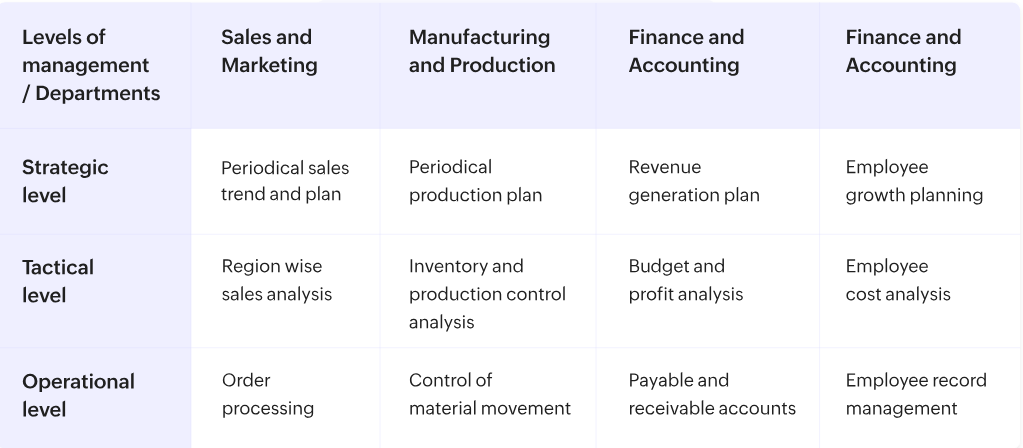
A management information system (MIS) is a set of systems and procedures that gather data from a range of sources, compile it and present it in a readable format. Managers use an MIS to create reports that provide them with a comprehensive overview of all the information they need to make decisions ranging from daily minutiae to top-level strategy. MIS in an organization is:
-
An integrated user-machine system
-
For providing information
-
To support the operations, management, analysis, and decision-making functions
An MIS can be developed to collect nearly any type of information managers require. They can view financial data such as daily revenues and expenses immediately and attribute them to specific departments or groups. Performance indicators such as the timeliness of projects or the quality of products coming off an assembly line can help managers pinpoint areas of needed improvement. Staff can manage schedules for work shifts, incoming deliveries and outgoing shipments from any place linked to the MIS.
The three levels of management expect MIS reports from four different departments to assess the company's performance and make smart moves
Forecasting
Forecasting is a fundamental tool used by operations managers to predict future business trends, customer behavior, and market conditions. It provides a roadmap for the organization, helping managers to plan and allocate resources effectively. For instance, if a forecast predicts an increase in demand for a product, the operations manager can plan to increase production capacity, order more raw materials, or hire additional staff. Conversely, if a decrease in demand is predicted, steps can be taken to reduce costs and prevent overproduction.
Two aspects of forecasts are important. One is the expected level of demand; the other is the degree of accuracy that can be assigned to a forecast (i.e., the potential size of forecast error. Forecasts are made concerning a specific time horizon. The time horizon may be fairly short (e.g., an hour, day, week, or month), or somewhat longer (e.g., the next six months, the next year, the next five years, or the life of a product or service). Short-term forecasts pertain to ongoing operations. Long-range forecasts can be an important strategic planning tool and pertains to new products or services, new equipment, new facilities, etc. Forecasting is an indispensable tool for operations managers. It enables them to plan effectively, make informed decisions, manage uncertainties, and measure performance.
Production Efficiency
Production efficiency, also known as productive efficiency, identifies the conditions in which goods can be produced at the lowest possible unit cost. To achieve production efficiency, one should utilize resources and minimize waste, which in turn, translates to higher revenues. Production efficiency looks at the maximum output you can achieve using the same assets that you already have.
Manufacturing productivity can be measured by contrasting the rate of output per unit of input used in the production process. Productivity increases when the same quantity of inputs results in more outputs, or when you get the same output quantity using fewer inputs.
It’s important to note that measuring labour hours as the sole input is only a partial measure of productivity. Multifactor productivity = Units of Output / (Units of Labor + Units of Capital + Units of Materials). Using this method results in a more accurate ratio than using labour alone because changes in capital and materials used in production may also increase or decrease labour costs.
Inventory Management
Inventory refers to a company’s goods and products that are ready to sell, along with the raw materials that are used to produce them. Inventory can be categorized in three different ways, including raw materials, work-in-progress, and finished goods.
Inventory management is important for businesses of any size. Knowing when to restock inventory, what amounts to purchase, and what price to pay can easily become complex decisions.
A reorder point, or ROP indicates an inventory item’s minimum stock level at which new stock should be ordered to avoid a stockout. It can thus also be viewed as the last time to replenish stock to avoid a stockout.
ROPs are always calculated separately for each individual item. The calculation consists of an item’s delivery time, demand or consumption rate, and, if applicable, its safety stock level. Since all of these are dynamic variables, the ROP of an item can vary greatly depending on changes in the supply chain, market circumstances, selected suppliers, etc. The ROP model is based on analyzing historical consumption and lead time data to predict consumption rates.
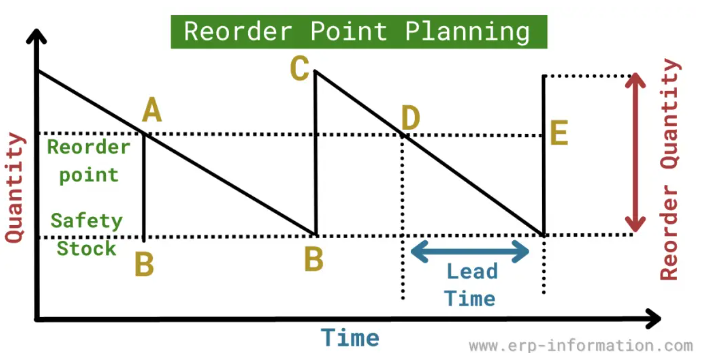
As the above graph visualizes, lead time represents the amount of time in days it takes for items to become available from the moment they are ordered. It is thus an instrumental part of the ROP calculation and helps to avoid inventory levels falling below the safety stock line.
Supplier selection
Suppliers provide inputs to the operations system. They may supply raw materials, components (as in car assembly), finished products (for example a pharmaceutical company providing drugs to a hospital, or an office supplies company providing it with stationery), or services (as in the case of a law firm providing legal advice).
Finding and choosing suppliers can be particularly challenging because organizational requirements are quite diverse. On top of that, not every single standard can be precisely matched, despite the numerous options. Suppliers can be chosen on the following factors:
Cost efficiency – With this process, companies can compare the offers from various third-party vendors or service providers and pick the one offering the most competitive pricing.
Quality assurance – Finding the most appropriate suppliers through this meticulous system ensures high-quality goods and services without worrying about defects or rejects.
Risk mitigation – One of the steps in the procedure identifying threats in quality, finances, and ethics, and ensuring that are measures to mitigate these risks.
Supply chain reliability – Disruptions in the supply chain, such as late deliveries or materials scarcity, could impede operations. By reviewing suppliers through this process, companies can assess their dependability.
Long-term collaboration – Compatibility, shared values, and mutual goals are factors companies often look for in their suppliers, resulting in enduring partnerships.
-
-
102
LO2 Reading Materials
-
103
LO2 Case Study Insights
-
104
LO2 Game ⭐
-
105
LO3 Notes
-
106
LO3 Reading Materials
-
107
LO3 Case Study Insights
-
108
LO3 Game ⭐
-
109
LO4 Notes
-
110
LO4 Reading Materials
-
111
LO4 Case Study Insights
-
112
LO4 Game ⭐
-
113
Feedback Form: Operations and Project Management
-
114
OPM_Game Reflection Note
-
115
Project Phases
Introduction
The Strategic Impact Simulation Project is a core component of the MBA program designed to enable learners to undertake an independent, research-based investigation of a complex business scenario derived from a gamified MBA module. Learners select a gamified mission scenario and conduct a research-based analysis to evaluate strategic decisions, outcomes, and leadership impact.
The project requires learners to critically examine a strategic management challenge by applying relevant academic theories, analytical frameworks, and evidence from scholarly and industry sources. Through this project, learners are expected to demonstrate the ability to integrate knowledge acquired across the MBA program, formulate a clear research focus, analyze alternative strategic decisions, and evaluate their implications for organizational performance and broader business contexts.
The project provides an opportunity to develop:
-
Critical thinking and decision-making skills in a global business context
-
Cross-functional integration across marketing, finance, human resources, operations, and sustainability
-
Practical experience in linking academic theory to business strategy
The work must be grounded in scholarly research and critical literature, ensuring that strategic insights and recommendations are supported by established theory and evidence-based analysis. The project therefore serves as a culminating assessment that evaluates learners’ independent research capability, analytical thinking, and ability to connect academic knowledge with practical managerial decision-making.
Learning Outcomes
Upon completion, learners should be able to:
-
Critically analyze a selected gamified business scenario by applying academic theories, frameworks, and industry evidence to identify and diagnose strategic challenges.
-
Design and evaluate alternative strategies using cross-functional knowledge to assess risks, model decision pathways, and anticipate outcomes.
-
Synthesize and interpret evidence, both qualitative and quantitative, to evaluate the effectiveness of decisions, demonstrating scholarly research skills, ethical awareness, and informed managerial judgment.
-
Develop actionable recommendations that are supported by critical reflection on leadership, professional development, and the broader societal impact of strategic decisions.
-
-
116
Report Structure
-
117
Assessment and Marking Scheme
-
118
Strategic Impact Simulation Project Document